Sharp and frequent, at last
Planet's Pelican fleet is built to photograph any spot on Earth up to ten times a day at 30-centimeter detail — sharpness and cadence that satellite buyers used to have to choose between.
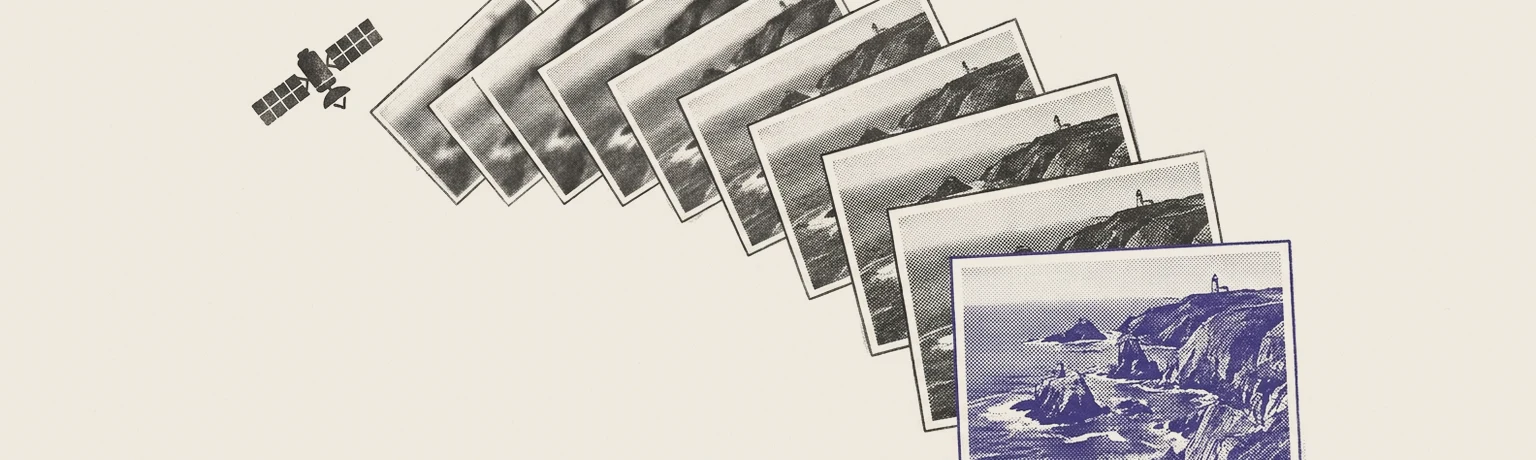
For two decades, commercial Earth imaging forced a choice. You could have sharp — Maxar has sold 30-centimeter pictures, fine enough to count cars, since 2014 — but it passed over any given place rarely. Or you could have frequent: Planet's own flock of shoebox-sized Doves has photographed the entire planet every day since the 2010s, but only at three-to-five-meter resolution, where a car is a smudge. You did not get both.
The role reversal is the tell: Planet, long the daily-but-blurry player, is now profitable and chasing high cadence at high resolution — while Maxar, the sharp-but-occasional incumbent, is the one playing catch-up.
Pelican is Planet's bet that you can. The full constellation is 32 satellites, nine of which are already on orbit; the sharper second-generation craft, at 30-centimeter-class resolution, begin launching late in 2026. At full scale the fleet is designed to revisit any point on the globe up to ten times a day, and up to thirty times at the mid-latitudes where most people live. A port, a construction site, a column of trucks stops being a snapshot and becomes something close to a running record.
The catch worth naming: this is a roadmap, not a delivered capability. The satellites flying today are the coarser 50-centimeter generation, and the once-an-hour-or-better cadence only arrives once the constellation is built out. Even the speed of delivery is often overstated — getting a fresh image from order to screen takes Planet two to four hours now, not minutes, though onboard processing that decides what is worth sending down is meant to shrink that.
If it lands, the first customers are the ones already paying: defense and intelligence agencies, who want to know what changed at a place since yesterday. But near-continuous ground truth at sub-meter detail is the kind of utility that leaks outward — to shipping, insurance, crop monitoring, and the open-source investigators who now routinely catch governments in the act.
The lenses
The facts
Concepts
How this connects
Tap a node to open it